FUTURE CITIES
| DESIGN COMPETITION |
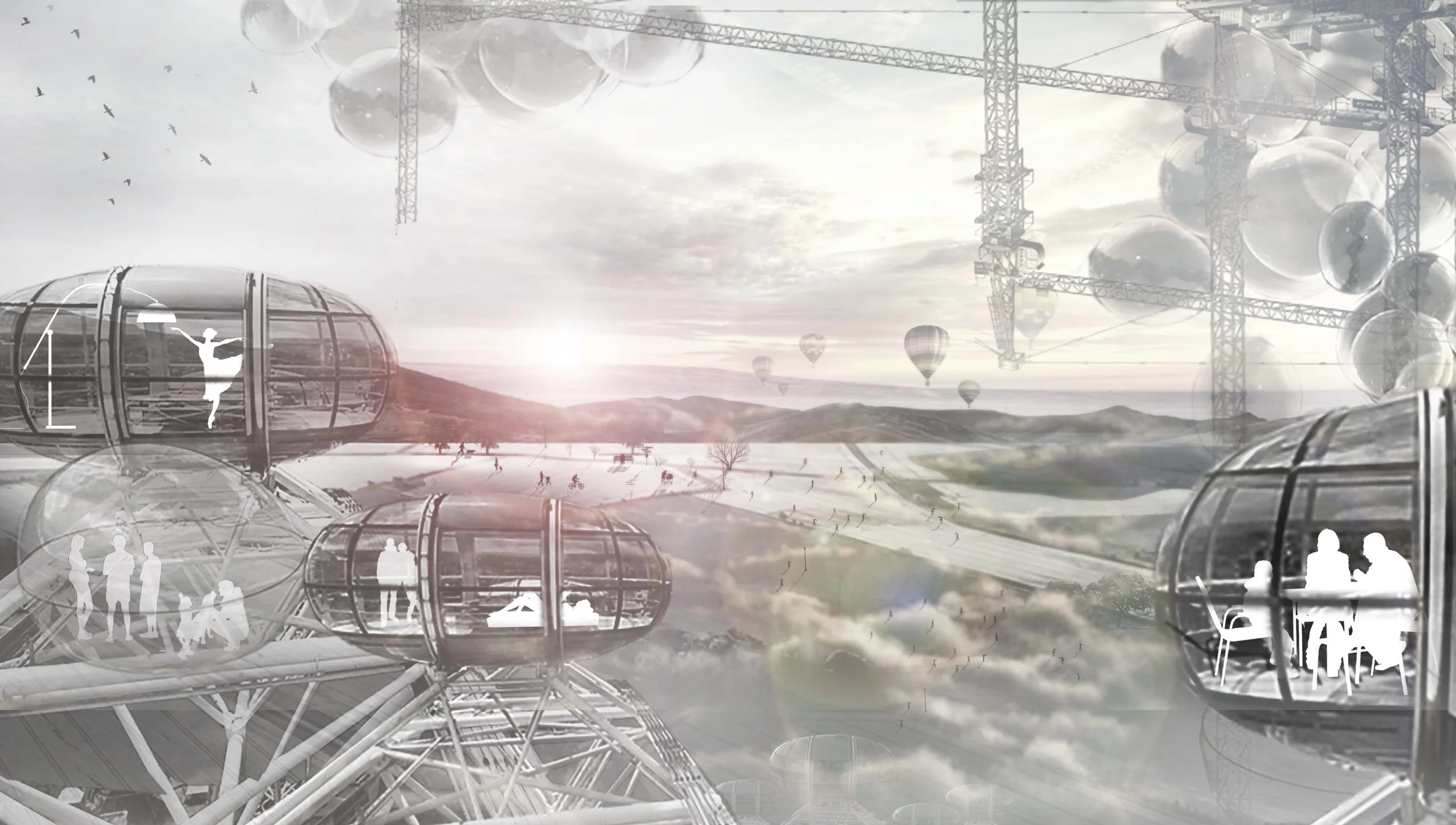
As I step out, I recognize this town. I was here in 2016 AD. There are no streets or buildings, the roads are no longer filled with cars like they used to. As I look up, all I can see is a swarm of what look like pods rising over a sea of green parks. The street is the park. Occasional incoming fog obscures my view, but then this is a foggy city, it was and it always will be.

The incoming fog settles on the cluster. A large shout from a mobile pod operator distracts me. I see people descending into the street park in random spurts. Rustling sound of the foliage masks their conversations. But I am eager to listen. I lean forward.
I am happy to subscribe to this city, Dorothy. The urban fabric reminds me of Jericho in 9000 BC. We lived in a house that had direct access to the roof, the collection of roofs within the cluster was the street in Jericho. But I like coming down to the park, better now without cars. I agree. The air is cleaner, the environment is greener, her friend responds.
It is spring here. The climate crisis is a thing of the past. Resilient measures taken in 2100 AD to combat climate change are now accepted ways of life. Rising sea level was the primary factor for elevating a cluster. Sea levels are now aligned with levels of 1800 AD but the cluster developments stays put. Subscribers to the city like the altitude.
I am fortunate to be given the right to travel in the spectrum of 9000 BC to 2400 AD. Alignment of economic and technology innovations have reset the course of civilization, expanded the scale, modified human activity patterns and changed settlement typologies. Architectural manifestos through time have been their business models.
Agriculture was the key economic driver that made Jericho happen in 9000 BC. Rise of civilization fortified towns. Industrialization is the current metropolis. Barter, metal coins, paper money, and credit are the instruments required for living in the spectrum. The shift in economies morphed its currency along the way. Market conditions favor human pollination. A diverse society is in works since trade started between Mohenjo-Daro and Mesopotamia. The spectrum is a variation of economic shifts and human migration. Soft and rigid like clay, cities are formed by external pressures and baked into entities until they melt and become another.
A loud "Hi," pulls me away from my nostalgic thoughts. Abby, a friend who had invited me to visit her, gives me a big hug. Yes, everyone in the future still say hi. Only an invitation can grant you access and subscription to this town. Abby explains a bit more of this foreign concept to me.
Alibaba, the digital market place equals the size of the Grand Bazaar of Constantinople in 1455. The success of Alibaba's subscription business model appeals to city mayors, especially after the financial crisis of 2050 AD. Subscription to a city grants you the rights to live in a city. Citizens are now Subscribers. And if you were a prior subscriber to Alibaba then you get preferred access to it. "I was an early Alibaba subscriber hence I was pre-approved for this cluster, I mean a city," Abby says with pride. Cities are now called clusters. I retort back the question, are the publications of Citizen Kane now called Subscriber Kane? Abby is not amused, we set out to explore.
More people descend into the park. I am ready to leave. Abby hails a mobile pod with few taps on a mobile kiosk. An orange capsule comes to us. Abby decides to travel home in Indian cafe pod. We settle in with our food. This seems convenient I acknowledge to her –retail and restaurants mobile pods are the means of transportation – she nods her head and points me to look out. I feel the climb up.
The mobile pods are iterations of elevators that move horizontal, vertical and sideways. Elisa Otis would have never imagined how her invention could have made possible the cities of the future. I make a mental note to meet her when I go back to 1854 AD. The orange pod moves into the cloud, I finish my rice and curry and gaze out. The parks at the street level looks like a green carpet from my viewpoint. The fog and the green below make me believe the Garden of Eden is exactly as illustrated on the postcard invitation that Abby sent me.
Abby informs me that she has a Tier III subscription, which extends healthcare coverage to visitors. I give her a confused look; she explains further how the subscription works for future cities. Basic tier subscription includes housing, city transportation and access to open spaces. Tier II includes benefits of clean air and energy. Tier III offers you education and healthcare services, visitors included. A six- month subscription is the minimum.Subscription is paid in water credits. Electronic transfer of water credits is the currency of all cities now. Valuation is pegged to desalination plants and reservoirs capacity, the mints and banks of cities. Similar to when paper currency was leveraged against gold reserves in 1800-1900 AD, I quip back. Abby helps me to convert my paper money into water credits electronically. Water credit is the currency for all purchases. The conversion rate seems bit complicated; I decide to not dwell on this.
"What elevation would you like for the bedroom to be at?" Abby asks as we descend from the mobile orange pod. "I need to schedule it soon." My silence is a testament to my ignorance. Apartments in a cluster are modules that are mobile and connect as needed. My apartment currently is three modules, one living room and a kitchen, one bedroom and one bathroom. Each of these modules are independent, I have chosen this configuration for the next two months. After that I lose my bedroom to another subscriber on the south side of the cluster. I save credit in doing this. My bedroom self-detaches and moves towards the location of the new subscriber. Similarly when my bathroom needs repairs it travels to the manufacturing warehouse to get itself fixed. Today I have a choice to detach my bedroom and move it to a higher elevation without additional cost, part of my Alibaba subscription benefit. My mind is trying to grasp the concept. "As high as I can go," I answer back. I think back about how limiting the two-/three- bedroom fixed configurations were back in 1980 AD.
Abby shows me how to adjust the elevation of my bedroom, she settles on the couch for the night. I am excited. I retreat to my room and start the climb. Through my window I see the entire cluster reconfiguring itself. The future city has no form indeed. The fluidity is experienced here more than ever. This is Jericho of 9000 BC, Manhattan of 1950 AD and Alibaba of 2100 AD all happening together. The fog starts clearing up as more of the cluster becomes visible. The reference to mythology is relevant now. Like ancient gods, humans now live on the clouds, descend back to earth every day to experience the Garden of Eden and then retreat back to the cloud. The new subscribers have let go of all the nostalgia of the past, solved climate crisis, and have given back water its true intrinsic value. The fluid form of the city is still changing, but my tired eyes give away. As I drift into another zone in the spectrum I go to sleep remembering an old English expression:
"May you live in interesting times"